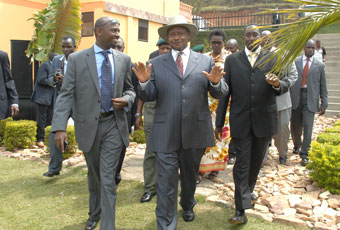
These are quotes and excerpts that are intended to give flesh to the famous or infamous 2005 incidents that landed Andrew Mwenda into prison and later resulted into a constitutional challenge of sedition as a crime. The choice of the 2005 incident starring Andrew Mwenda and Yoweri Museveni as lead actors does not mean that Andrew Mwenda is the only Ugandan who has suffered the increasing tendency of the state to suppress freedom of expression but rather because his harassment is better documented compared to the radio journalist who is harassed for praising an opposition candidate on his show or Mr. Gawaya Tegulle who was dismissed from UBC (Uganda’s public broadcaster) for hosting a leader of one of Uganda’s political parties among many other incidents, including the 2009 closure of CBS (a kingdom owned radio).
Museveni on August 10, 2005 at Kololo Airstrip said;
“These newspapers, I am the elected leader of Uganda. I therefore have the ultimate mandate to run their affairs. I will no longer tolerate a newspaper which is like a vulture… I will simply close it. Finish. End. Gasiya tu. I have been seeing this young boy, Mwenda, writing about Rwanda, writing about Sudan, writing about UPDF, he must stop. Completely. He is an expert on SPLA, he knows the minutes which took place where… he must stop. And this other paper called Observer, what is being said in the army. This is not how a country is run… Red Pepper also. I thought those were confused young boys busy with naked girls… These newspapers must stop or we shall stop them. If they want to continue doing business in Uganda, they must stop interfering in security matters of the region…”
Below is what the motor-mouth journalist, Andrew Mwenda delivered to his listeners on his evening show on KFM after Museveni’s words on August 10, 2005; (Andrew had hosted Presidential Assistant Moses Byaruhanga, Mr. Reagan Okumu, a Member of Parliament and ex-intelligence chief David Pulkol in studio that evening).
“… If he was elected, does that mean that other actors do not have views? … Does it mean that when people elect him, those who disagree with him should keep quiet? … You go and tell him to listen to this show, then he can get some wisdom, because all of you guys sit at State House and say, yes sir, yes sir. Here we say no sir… I can tell you, his little threats are completely ignored… Mwenda should not discuss security in the region, how can you say something like that? I don’t want… we run a newspaper and pay taxes which buy his suits, does he know that?… You see these African presidents. This man went to University, why can’t he behave like an educated person? Why does he behave like a villager?… But, how can he insult me like that? Museveni has no monopoly of irrationality, do you know that?… If he wants to behave like Saddam Hussein, let him go to Iraq… Peace and security is a public good… I think I understand security better than Museveni… That is what I think. I am a security expert… Oh, Jesus Christ! You really think laying the whole northern region, a third of the country, in waste, 20 years of war, is how you bring security into a country? Let him resign today, let me become President and you will see what I will do. This country will be better managed and there will be security all over the country. Security will no longer be a tribal good enjoyed by the Bantu in the south. Everybody in Uganda will be entitled to security. Museveni can never intimidate me. He can only intimidate himself… We are willing to pay Museveni a handsome pension if he decided to go home and rest and stop mismanaging this country. Why does he call me a boy?… Listen to me and you will get the correct security analysis. Listen to the President you will get the wrong one… The President is becoming more of a coward and everyday importing cars that armour plated and bullet proof and you know moving in tanks and mambas, you know, hiding with a mountain of soldiers surrounding him, he thinks that that is security. That is not security. That is cowardice… this one’s security is Jurassic security. Why does this one move with mounted anti-aircraft guns, AK 47 assault riffles, tanks and mambas, buffels and katyushkas, Jesus Christ? Actually Museveni’s days as a President are numbered if he goes on a collision course with me… I wish I was 35, I would have contested the next election… you mismanaged Garang’s security. Are you saying it is Monitor that caused the death of Garang or it is your own mismanagement?… Aah what caused Garang’s death? Garang’s security was put in danger by your own government putting him first of all on a junk helicopter, second at night, third passing through Imatong Hills where Kony is… Are you aware that Garang died in Imatong Hills where you have always complained that Kony is?… Are you aware that your Government killed Garang? … I would say the Government of Uganda, out of incompetence, led to or caused the death of John Garang. They put him on the plane when it was already late. That plane the President said it has the capacity to detect bad weather 100km away. Why couldn’t they detect the bad weather 100km away? … Let me challenge you. When a plane is taking off from place A going to place B, it is supposed to establish weather at place B. If the weather at place B was bad, why didn’t your people here decide not to go? Maybe you don’t recognize that the Government of Uganda is responsible for the death of Garang. Whether it is by commission or omission, the government of Uganda cannot run away from that responsibility.”
For those words, Andrew Mwenda, listed among the World’s most influential people for 2009 by US magazine Foreign Policy, is battling a sedition charge (one among many other charges) in the courts of law. He insists that sedition is an outdated law that does not meet the Ugandan constitutionality test (we await the decision of the constitutional court on his case).
Having read Mwenda’s words (I labored to quote them extensively) on that show in question that led to the temporary closure of the radio by the state and Mwenda’s own imprisonment, does it impress anyone in anyway that Mwenda’s talk that night was criminal or wrong for that matter? Following the extensive debate we have held over Kalyegira’s own tales of police questioning over stories that have not pleased the state, does the reminder of Mwenda’s ranting help the debate on freedom of expression in Uganda?
I will conclude with two quotes; in a Human Rights Watch interview, Hon. Kabakumba Matsiko, Ugandan minister of information on April 9, 2010 said; “No journalist should be afraid in Uganda except those that are seditious.”
In Charles Onyango Obbo and Andrew Mwenda v. Attorney General, Supreme Court of Uganda, Constitutional Appeal No. 2 of 2002, February 11, 2004; Justice Mulenga stated; “A person’s expression or statement is not precluded from constitutional protection simply because it is thought by another or others to be false, erroneous, controversial or unpleasant. Everyone is free to express his or her views. Indeed the protection is most relevant and required where a person’s views are opposed or objected to by society or any part thereof, as “false” or “wrong.” … A democratic society respects and promotes the citizen’s individual rights to freedom of expression because it derives a benefit from the exercise of that freedom by its citizens. In order to maintain that benefit, a democratic society chooses to tolerate the exercise of the freedom even in respect of ‘demonstrably untrue and alarming statements,’ rather than to suppress them.”