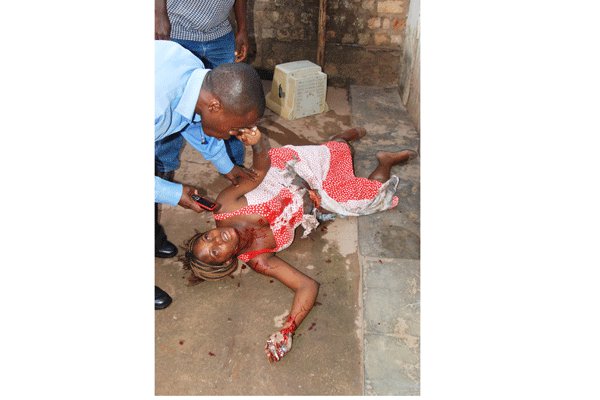
The Monday, April 25 2011 East African newspaper writes that the International Criminal Court (ICC) has dispatched a team to monitor the political situation in Uganda after reports of widespread police and military brutality in the ongoing Walk to Work campaign become regular. The East African quotes the ICC field outreach coordinator for Uganda, Ms. Maria Kamara as having said that the situation in Uganda is “an issue that is now public and before the international community,” adding that the Prosecutor has the latitude to move in anytime provided that human-rights organizations, observers and even ordinary Ugandans give sufficient grounds for an intervention.
There is no denying here, the ICC is monitoring the Uganda situation. We however know by now that monitoring a situation is not the same as opening an investigation. In fact, the ICC has in the past monitored many situations and stopped at that, without opening formal investigations. The prosecution has to assess the situation and have the judges determine if there is reasonable basis, as Ms Kamara rightly puts it. The police and military brutality in regards to the Walk to Work protests is an ongoing situation and definitely the ICC has not come to any conclusion in Uganda, again as Ms. Kamara rightly puts it. The situation is thus very much open. The probability of seeing heads roll over their acts/omissions that have led to deaths, massive arrests and detention and out-right persecution is not fictitious.
By now, the images of the dead two and half year old girl Julian have been seen and only the inhuman look away without shedding a tear on hearing that two bullets were used to shutter her life. Gross images of the effects of police and military brutality are eked somewhere on everyone’s mind, I mean those who have followed the Walk to Work protests. These brutal acts have not happened in one square-mile but have happened in Gulu where official accounts put the death rate at two, but might be higher, Jinja also saw several of these brutalities, so did Masaka, Kampala and other areas of the country. The brutality of the police and military against civilians has been very widespread and systematic.
The number of deaths is officially at five but I cannot trust that figure, the media crackdown during the protests has been hitherto unseen in the country. The number of the injured is much bigger, from the finger of Col. Dr. Kizza Besigye to hundreds nursing wounds in hospitals or even at home. The number of the arrested and detained is also in the hundreds. All these are civilians. And the perpetrators of these acts are armed police and military officers. The orders are to crush the protests, if the words of President Yoweri Museveni count for orders. He graphically called the crushing of the protests eating samosa and cake. In fact, police officers who have not tear-gassed, arrested, shot at protesters but have escorted the protesters to their places of work are being reprimanded for it. The case of Alphonse Mutabazi is clear. Those who are ordering and carrying out the shooting, tear-gassing, maiming, killing, and other inhuman acts remain protected by the police and military commander-ship.
The ICC has jurisdiction over four major families of international crime; war crimes, genocide, crimes against humanity and aggression. It is clear that Uganda is no war zone. We cannot therefore talk of war crimes as the violations of the Geneva Conventions of 1949 and breaches of the law of armed conflict as we agree that there is no war in Uganda. I would hesitate in using the genocide word either and of course there is no aggression here. The operative phrase in my view is “crimes against humanity.”
According to Article 7 of the Rome Statute of the ICC, crimes against humanity are specific acts committed as part of a widespread or systematic attack directed against a civilian population with the knowledge of the attack. Such acts include murder, imprisonment or other severe deprivation of physical liberty in violation of fundamental rules of international law, torture, persecution against any identifiable group or collectivity on political and other grounds universally recognized as impermissible under international law and other inhumane acts of a similar character intentionally causing great suffering or serious injury to body or to mental or physical health.
Attack directed against civilian population means a course of conduct involving the multiple commission of acts against any civilian population pursuant to or in furtherance of a state policy to commit such an attack. In my view, the state policy here is clear, suppress the protests, crush them. Persecution means the intentional and severe deprivation of fundamental rights contrary to international law by reason of the identity of the group or collectivity. The identifying of protesters as opposition supporters can qualify as identity and collectivity.
Individual criminal responsibility applies where a person orders, solicits or induces the commission of a crime which in fact occurs or is attempted. This also includes providing the means for the commission of the crime. Who issued orders for the murder of civilians? Who provided the teargas canisters, the live ammunition and other means used to commit the crimes we have seen?
Let us remember that Article 27 of the Rome Statute of the ICC removes any defense as official capacity of Head of State, Government or a member of government or any other official capacity. Military commanders or persons engaging as military commanders are responsible for crimes committed by forces under their effective command and control or effective authority and control per Article 28 of the Rome statute. Important is also Article 33 that waves a defense to criminal responsibility as having received an order of government or a superior.
Will Ocampo find work to do in Uganda this time in regard to the police and military reaction to the Walk to Work protests? Do you/we find that the provisions of the Rome Statute of the ICC as regards crimes against humanity, individual criminal and command responsibility apply to the military and police reaction to the Walk to Work protests? Should we as civilians, civil society and the media therefore start calling on Ocampo to open investigations in the conduct of the Ugandan police and military regarding the Walk to Work protests? Much as the situation is being monitored, the pressure and activism of citizens, civilians, media and civil society plays a role in informing the prosecutor as whether to open investigations in the situation.